[Case 02]
Improved Inventory Visibility & Decision-Making with Interactive Data Visualization
Aviation / SaaS
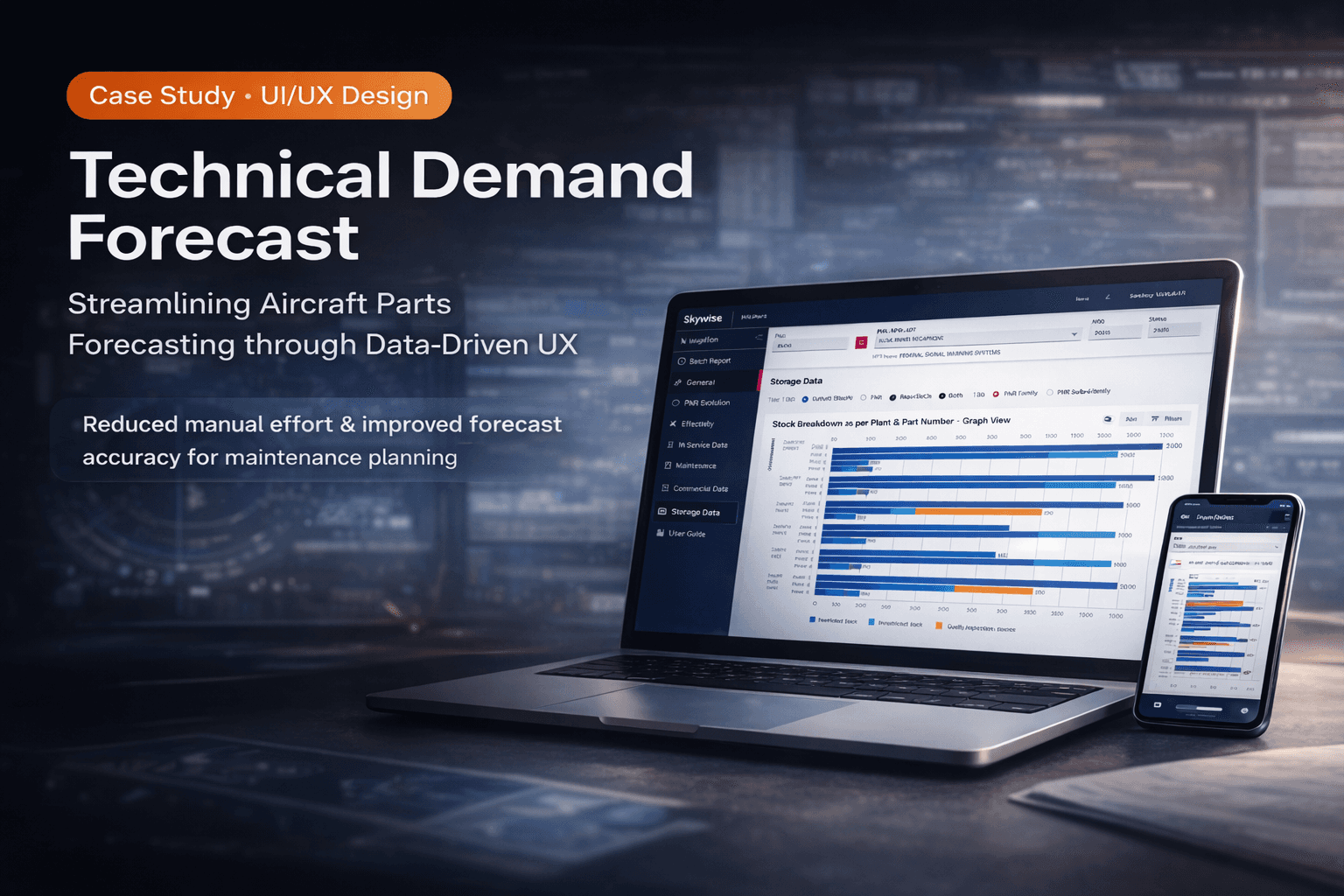
Designing an Enterprise Inventory Analytics Dashboard for Faster Decision-Making
Improving Data Visibility and Decision Efficiency with Interactive Visualization & Filtering
[Project Overview]
Led the design of a Technical Demand Forecast (TDF) tool to optimize inventory planning for Airbus maintenance operations. The existing process relied heavily on manual effort by engineers, making it slow, error-prone, and difficult to scale.
The redesigned solution consolidated data from multiple sources into a unified interface, transforming complex datasets into actionable insights. By introducing structured workflows, improved data visualization, and efficient processing mechanisms, the tool significantly reduced processing time and enabled faster, more reliable forecasting for procurement decisions.
[Problem Statement]
The existing demand forecasting process relied on manual data analysis across multiple systems, making it time-consuming, inefficient, and prone to errors. Engineers faced difficulty in consolidating data, interpreting outputs, and making timely decisions, resulting in delays and reduced operational efficiency in inventory planning.
[Industry]
Aviation / SaaS
[My Role]
Product Designer
[Platforms]
Desktop
[Timeline]
August 2025- October 2025
[Persona]

Clay Elliots
Material Forecast Engineer
I work with complex inventory and maintenance data daily, and I need a streamlined way to forecast demand without relying on manual calculations. A clear, unified view of data helps me make faster and more accurate procurement decisions.
Age: 39
Location: Hamburg, Germany
Tech Proficiency: Advanced
Gender: Male
[Goal]
Quickly analyze demand forecasts to identify required parts for upcoming maintenance
Make accurate, data-driven decisions for inventory procurement
Reduce manual effort by accessing consolidated and easy-to-understand data
[Frustrations]
Time-consuming manual process to gather and analyze data from multiple systems
Difficulty in interpreting complex datasets and identifying actionable insights
Lack of a unified view leading to inefficiencies in decision-making
[Process]
[01] User Research
Conducted interviews with Material Forecast Engineers and inventory planners to understand challenges in demand forecasting, data analysis, and decision-making workflows.
Analyzed existing workflows and system usage to identify inefficiencies in data processing, manual calculations, and time spent consolidating information.
Reviewed existing enterprise tools and industry practices to understand how complex inventory data can be better structured and visualized for faster insights.
[02] Insights
Users spent significant time manually gathering and consolidating data from multiple systems before making decisions.
Complex and unstructured data made it difficult for users to quickly interpret demand forecasts and identify required parts
Lack of clear visualization and filtering capabilities increased cognitive load and slowed down decision-making.
[03 Design Solution]
ntroduced interactive data visualizations to simplify complex inventory and demand forecast data.
Implemented advanced filtering and grouping mechanisms to help users quickly drill down into relevant data.
Structured data hierarchy and layout to improve readability and reduce cognitive load during analysis.
[04] Testing & Iteration
Conducted usability testing sessions with Material Forecast Engineers to evaluate how effectively users could analyze demand data and complete forecasting tasks.
Gathered continuous feedback through stakeholder reviews and usability testing, iterating on data visualization, filters, and layout for better clarity.
Refined the interface by improving data grouping, enhancing readability, and optimizing workflows to reduce time spent on analysis.
[Outcome]
Reduced time required to analyze demand forecast data by 35%, enabling faster decision-making.
Improved efficiency in identifying required parts and inventory gaps by 30%.
Enhanced user confidence and usability, improving perceived ease of use by 40%
[Key Learnings]