[Case 01]
Designed a scalable Digital Component Passport enabling end-to-end aircraft traceability, improving data reliability and reducing compliance risks across stakeholders.
Aviation (Enterprise SaaS)
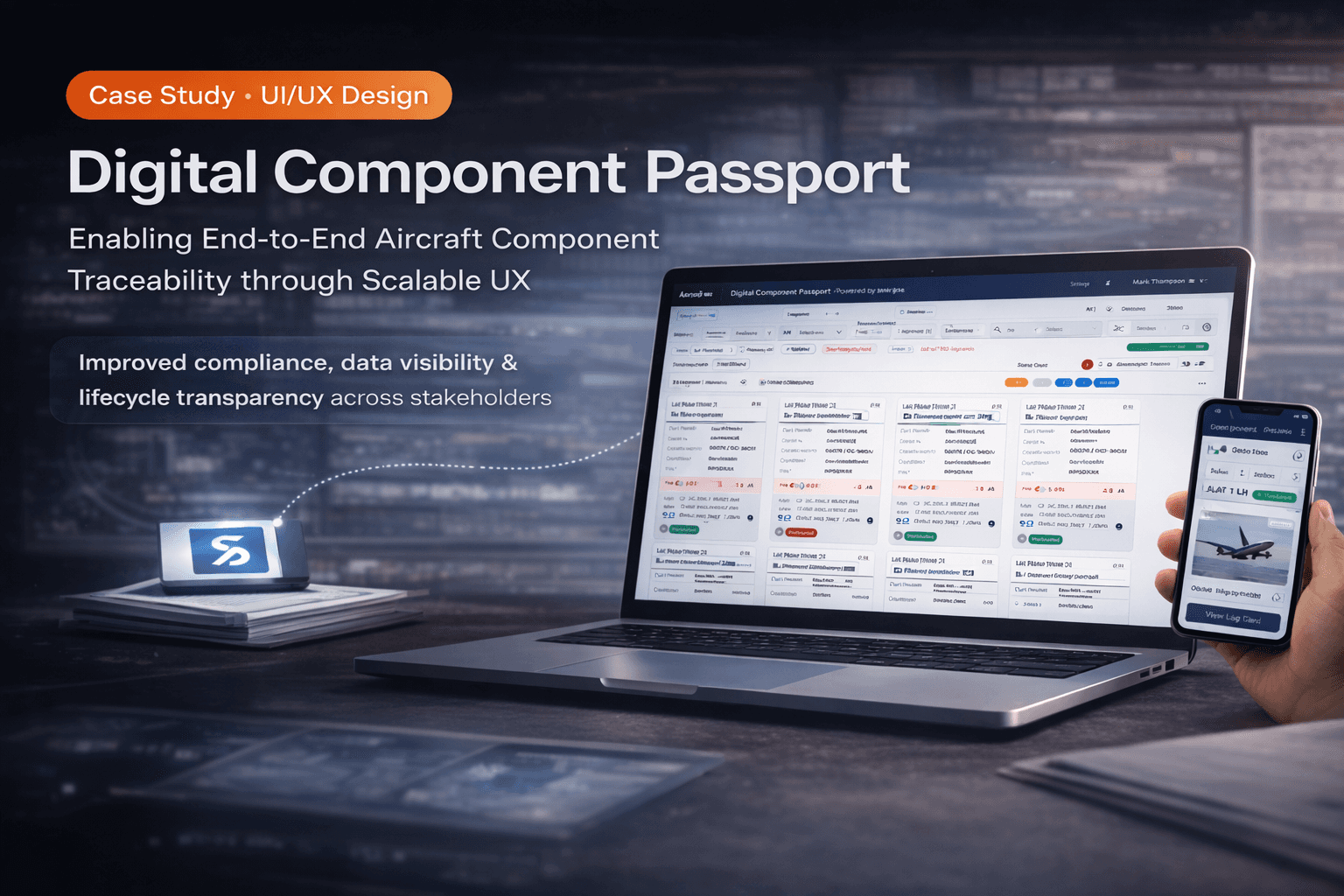
Reimagining Aircraft Component Traceability with a Digital Component Passport
Designed a scalable enterprise platform to unify component lifecycle data, streamline compliance workflows, and enable secure ownership transfers across the aviation ecosystem.
[Project Overview]
Aircraft component data is critical for safety, compliance, and operational efficiency—yet it is often fragmented across manufacturers, airlines, MROs, and regulatory bodies. Legacy systems rely heavily on paper records and disconnected tools, leading to inconsistent data, delayed validations, and increased compliance risks.
To address this, Airbus envisioned a Digital Component Passport (DCP)—a centralized, single source of truth for component lifecycle data across stakeholders.
As a Product Designer, I led the end-to-end UX design of this enterprise platform, translating complex regulatory requirements and multi-stakeholder workflows into intuitive, scalable experiences. I designed systems that enable users to track component history, validate records, and securely transfer ownership while maintaining full auditability.
The solution introduced structured digital workflows, real-time visibility, and standardized data models—reducing manual effort, improving data reliability, and enabling seamless collaboration across the aviation ecosystem.
[Problem Statement]
Aircraft component traceability at Airbus is challenged by fragmented systems, inconsistent data, and manual logcard processes across multiple stakeholders. Critical lifecycle information—such as installation history, flight cycles, and compliance records—is often incomplete, duplicated, or difficult to access.
The absence of a unified and reliable system leads to delays in validation, increased compliance risks, and reduced operational efficiency during maintenance, audits, and ownership transfers.
[Industry]
Aviation (Enterprise SaaS)
[My Role]
Product Designer
[Platforms]
Web
[Timeline]
August 2023- Present
[Persona]

Micheal Atherson
Airworthiness Assessor – Aircraft Components
I am responsible for ensuring the airworthiness and regulatory compliance of aircraft components by validating their complete lifecycle data. I rely on accurate, complete, and easily accessible records to make critical decisions under time pressure—especially during audits, maintenance operations, and ownership transfers. Any missing or inconsistent data increases risk, delays processes, and impacts operational efficiency.
Age: 42
Location: Toulouse, France
Tech Proficiency: High (Domain Expert)
Gender: Male
[Goal]
Ensure complete, accurate, and compliant lifecycle data for every aircraft component.
Quickly validate and approve component records with minimal manual effort.
Access full component history instantly during audits, maintenance, or ownership transfers.
[Frustrations]
Fragmented systems and disconnected data sources make it difficult to get a single, reliable view
Manual paperwork and inconsistent logcards lead to errors, duplication, and delays.
Lack of real-time visibility into component status and history across stakeholders.
[Process]
[01] User Research
Conducted in-depth stakeholder interviews with airworthiness assessors, MRO teams, compliance experts, and airline operators to understand workflows, pain points, and decision-making needs.
Analyzed existing AS-IS workflows and system dependencies across OEM, airline, and MRO ecosystems to identify gaps, redundancies, and inefficiencies.
Reviewed aviation regulatory requirements (EASA) and audit processes to map compliance needs and ensure alignment with industry standards.
[02] Insights
Component lifecycle data is fragmented across multiple systems and formats, making it difficult to establish a single source of truth.
Validation and approval workflows are error-prone due to unclear data ownership, lack of status visibility, and inconsistent data structures.
Users rely heavily on manual effort to collect, verify, and reconcile component records—especially during audits and ownership transfers.
[03 Design Solution]
Designed a centralized Digital Component Passport (DCP) to unify lifecycle data and create a single source of truth across stakeholders.
Introduced structured workflows with clear data ownership, validation states, and audit trails to reduce errors and improve transparency.
Enabled seamless data integration and digital record management to minimize manual effort and improve efficiency during audits and transfers.
[04] Testing & Iteration
Conducted usability testing sessions with domain experts (airworthiness assessors and MRO users) to validate workflows, identify usability gaps, and gather actionable feedback.
Iterated on validation and rejection flows to reduce ambiguity, improve error handling, and provide clear, contextual feedback for faster decision-making.
Refined information architecture and dashboard experiences to enhance visibility of component status, lifecycle data, and compliance indicators
[Outcome]
Significantly reduced manual effort in component data validation and documentation review.
Enhanced lifecycle visibility and traceability
Enhanced compliance readiness and audit confidence with structured workflows
[Key Learnings]